
Structured Wiring · Prewire · Certification
Low Voltage Wiring in Charlotte, NC
Structured cabling is the one part of a technology environment that cannot be upgraded later without opening walls. We design and install it as permanent infrastructure — documented, labeled, tested, and serviceable.
The Short Answer
What residential low-voltage wiring covers
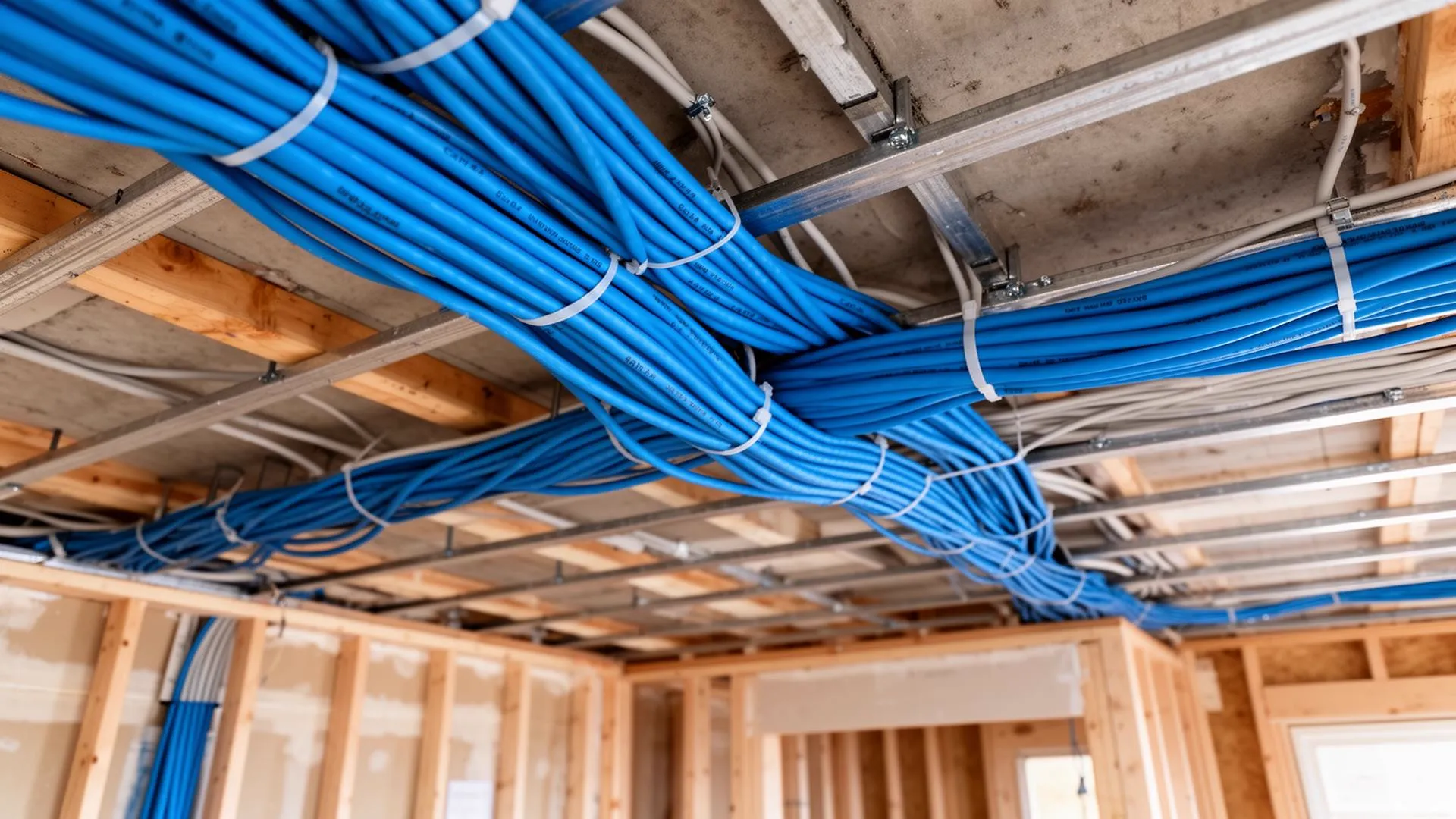
Low-voltage wiring is the structured cabling that carries data, audio, video, control, and camera signals through a home — Cat6 and Cat6A network runs, speaker cable, coax, fiber backbone, shading and keypad control wiring, and the equipment room where all of it terminates.
It is installed at rough-in, after framing and mechanical and before insulation. Every drop is labeled at both ends, data runs are tested and certified, and the results are delivered as as-built documentation your builder and any future integrator can work from.
Scope & Investment
Low voltage wiring cost by scope
| Scope | Typically includes | Stage | Investment |
|---|---|---|---|
| Network & data prewire | Cat6/Cat6A home runs to every TV, access point, camera, rack, and workstation location; terminated and certified | Rough-in | $4,000 – $18,000 |
| Audio prewire | 16/4 and 14/2 speaker runs to in-ceiling and in-wall locations, backing boxes, subwoofer and outdoor stubs | Rough-in | $5,000 – $30,000 |
| Theater & media room infrastructure | Conduit to projector and screen, immersive speaker layout wiring, riser power coordination, acoustic backing | Rough-in | $6,000 – $40,000 |
| Whole-property structured wiring | Data, audio, video, camera, intercom, shading, and control wiring plus equipment room design and rack elevations | Design through trim | $20,000 – $120,000+ |
Ranges reflect Peters Audio Video project scopes in the Charlotte market and vary with square footage, device count, run lengths, and equipment room complexity. Every project is priced from a written wiring schedule.
Method
How a wiring package is executed
01
Plan review
We mark up architectural and electrical drawings — device locations, rack placement, conduit paths, and coordination notes for the electrician and framer.
02
Wiring schedule
A written low-voltage schedule documents every home run by type, gauge, destination, and label so the field crew and the builder work from the same document.
03
Rough-in
Cabling is pulled, labeled, and protected before insulation. Speaker backing, display blocking, conduit sleeves, and box locations are set to finish tolerances.
04
Certification
Data runs are terminated and tested for continuity and performance. Test results are recorded against the schedule and delivered as project documentation.
05
Trim-out
Keypads, plates, speakers, access points, and cameras are installed after paint, and the equipment rack is dressed, powered, and cooled.
06
Documentation & service
As-built wiring documentation, rack elevations, and IP schedules are handed over, then maintained under our concierge program.
Common Questions
Low voltage wiring questions
What is low-voltage wiring in a home?
Low-voltage wiring is the structured cabling that carries data, audio, video, control, and camera signals through a house — typically Cat6 or Cat6A network cable, speaker cable, coax, fiber, and control wiring. It is separate from line-voltage electrical work and is installed during rough-in, before insulation and drywall.
How much does low-voltage wiring cost in Charlotte, NC?
Network and data prewire for a custom home typically runs $4,000 to $18,000. Audio prewire ranges from $5,000 to $30,000 depending on zone count. A whole-property structured wiring package covering data, audio, video, cameras, intercom, shading, and control generally falls between $20,000 and $120,000+. Pricing is driven by square footage, device count, and how many runs terminate at a single equipment room.
When should low-voltage wiring be installed during construction?
After framing and mechanical rough-in, and before insulation and drywall. Waiting until after drywall forces retrofit paths, reduces speaker and camera placement options, and can double labor. Design should begin earlier still — during architectural drawings — so rack space, conduit, and device locations are on the plans.
Should I run Cat6 or Cat6A in a new home?
Cat6 supports 1 Gb everywhere and 10 Gb over shorter runs, and is appropriate for most residential drops. Cat6A is worth the additional cost for backbone runs between equipment rooms, for Wi-Fi 6E/7 access points, and for long runs across large estates. In practice we specify Cat6A for infrastructure and access points, Cat6 for general device drops, and conduit where future media is likely.
Do you perform electrical work?
No. Peters Audio Video installs low-voltage systems only. We coordinate closely with your licensed electrician for dedicated circuits, rack power, lighting control panels, and any line-voltage work required by the design.
Can low-voltage wiring be added to an existing home?
Yes. Retrofit wiring uses attic and crawlspace paths, existing chases, and interior soffits, supplemented with wireless backhaul where structure does not allow a cable path. Placement options are narrower than in new construction, but most homes can be brought to a fully wired standard with careful survey work.
Get the wiring right once
Send us your plan set and construction schedule. We will return a low-voltage schedule, rack location recommendation, and budget range before rough-in.
Request a Wiring PlanCharlotte, North Carolina
Talk with us about your project in Charlotte
Monday–Friday, 8:00–5:00. Evenings and weekends by appointment.
Where we work
We design and support estate technology across the Charlotte metro area, working from our SouthPark office with builders, architects and homeowners.
All service areas