
Product Category
Video Distribution Systems
Matrix Switching & AV-over-IP for Whole-Estate Content Distribution
Overview
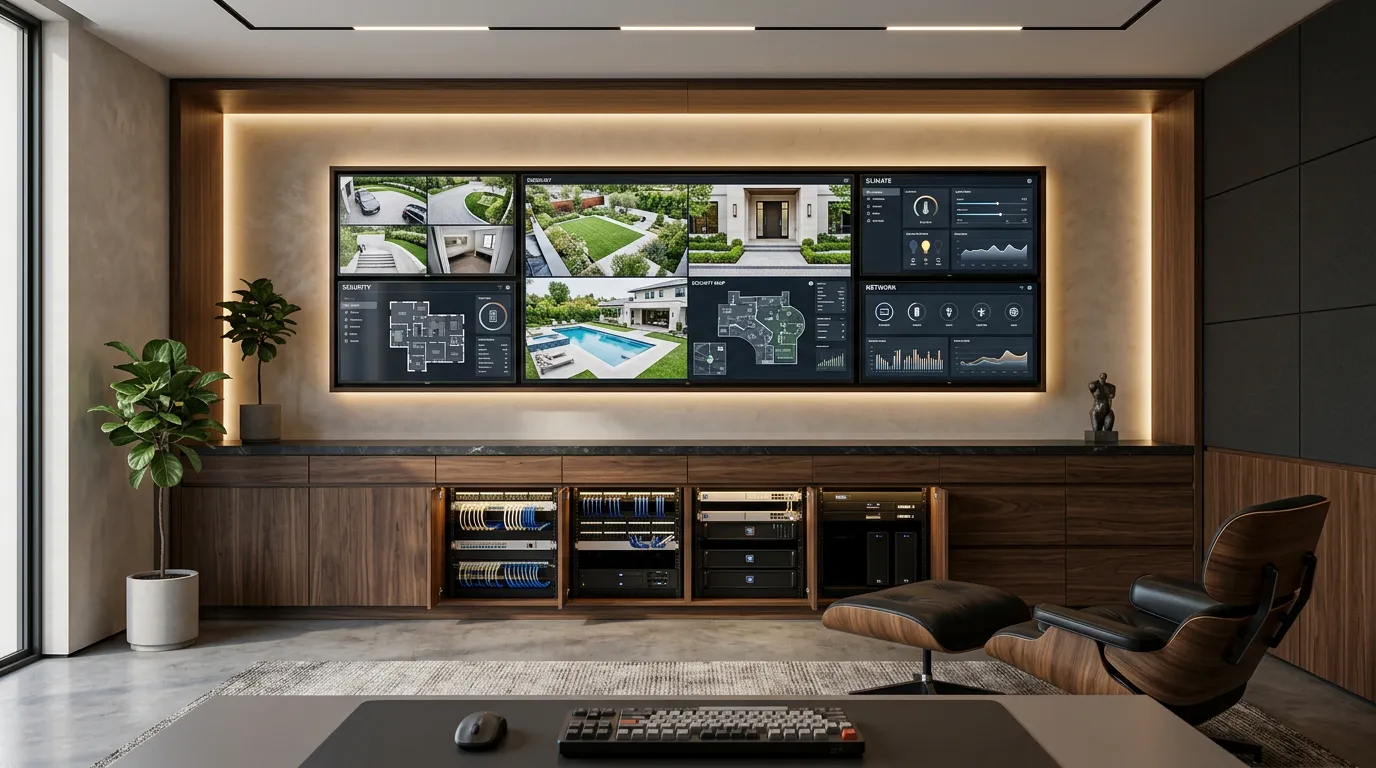
Video distribution is the invisible backbone that delivers any source to any screen in the estate — cable boxes, streaming devices, Blu-ray players, gaming consoles, and security cameras routed to any display with a single touch.
Modern AV-over-IP platforms have replaced traditional HDMI matrix switches with network-based distribution that scales to virtually unlimited zones and supports 4K HDR with zero-latency switching.
Peters Audio Video designs video distribution architectures that integrate seamlessly with Savant and Control4 automation — one-touch source selection from any room, any device, to any display.
What We Design
Design Capabilities
AV-over-IP network-based video distribution
HDMI matrix switching for centralized source management
4K HDR with zero-latency room switching
Multi-viewer displays showing multiple sources simultaneously
Distributed gaming with controller pass-through
Integration with Savant and Control4 automation
Our Portfolio
Brands We Specify — Video Distribution Systems
Snap One
Infrastructure
The Integration Platform — Unified Infrastructure for Professional Smart Home Installation
Middle Atlantic
Infrastructure
Premium Equipment Infrastructure — Racks, Power & Thermal Management for AV Excellence
Strong
Infrastructure
Professional Mounting & Rack Solutions — Engineered for Custom Integration
Panamax
Infrastructure
Premium Power Protection — Surge Suppression & Power Conditioning for Estate AV Systems
Furman
Infrastructure
Professional Power Conditioning — Studio-Grade AC Protection for Critical AV Systems
SurgeX
Infrastructure
Advanced Mode Surge Elimination — The Most Sophisticated Power Protection Available
WattBox
Infrastructure
Smart Power Management — OvrC-Enabled Remote Power Control for Intelligent Estates
CyberPower
Infrastructure
Reliable UPS & Power Distribution — Cost-Effective Protection for Smart Home Infrastructure
Common Questions
Video Distribution Systems — Frequently Asked Questions
What is a video distribution system?
A video distribution system routes any video source — cable and satellite boxes, streaming devices, Blu-ray players, gaming consoles, and security cameras — to any display in the home from a centralized equipment rack. Sources live in one climate-controlled location; every television simply receives the feed it is asked for, so no room needs its own stack of devices.
What is the difference between an HDMI matrix and AV-over-IP?
An HDMI matrix is a fixed-size switcher (for example 8x8 or 16x16) that hard-wires a set number of sources to a set number of displays. AV-over-IP sends the same video over a managed 10G network switch, so zones are added by adding an endpoint rather than replacing the switcher. Matrix systems suit homes under roughly 10 displays; AV-over-IP scales to unlimited zones and is the standard specification for estates.
How much does whole-home video distribution cost?
A centralized HDMI matrix system for 6–10 displays typically runs $12,000–$28,000 installed, including the matrix, receivers, rack, and control integration. AV-over-IP estate systems supporting 15–40 displays generally range from $45,000 to $150,000 depending on encoder count, network infrastructure, and video wall or multi-viewer requirements.
Does video distribution support 4K HDR and Dolby Vision?
Yes. Current-generation matrix and AV-over-IP platforms carry uncompressed or visually lossless 4K60 4:4:4 with HDR10, HDR10+, and Dolby Vision metadata intact, plus HDCP 2.3 handshaking so protected streaming sources play on every display.
What cabling does a video distribution system require?
Category 6A shielded cable to every display location is the baseline, with fiber runs for distances beyond roughly 300 feet or for 10G AV-over-IP backbones. Pulling two Cat6A runs per television during rough-in is the single most valuable future-proofing decision a builder can make.
Can video distribution integrate with Savant or Control4 control?
Yes. We program source selection, room presets, and multi-viewer layouts directly into Savant and Control4 interfaces, so the distribution layer is invisible — a client selects “Living Room → Golf” rather than thinking about matrix inputs.
Design Your Video Distribution Systems System
Every video distribution systems installation begins with a conversation about your home, your lifestyle, and the experience you want technology to deliver.