
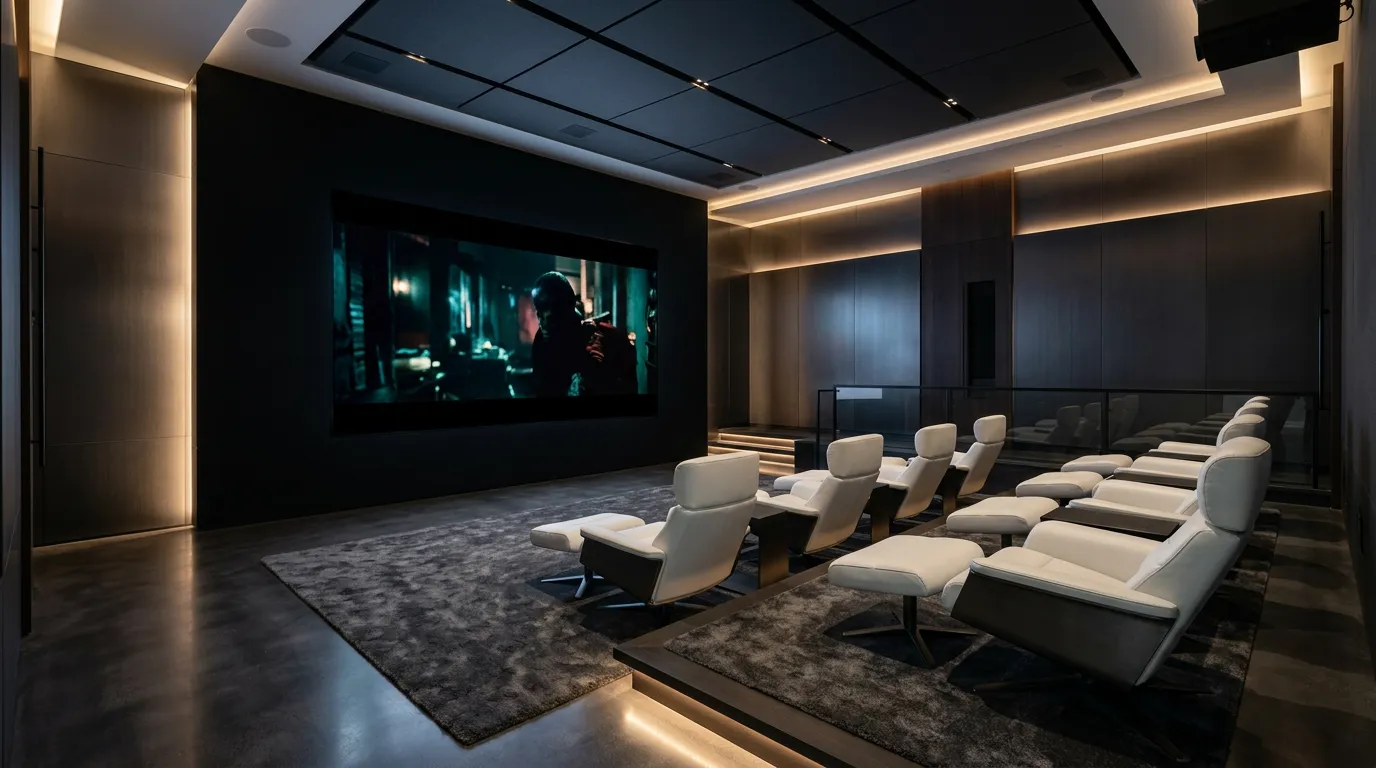
Projection Screens
Stewart Filmscreen
The Reference Standard in Projection Screen Technology
Request System DesignOverview
Stewart Filmscreen is the most respected projection screen manufacturer in the world — the only screen company whose products are used by Hollywood studios, IMAX theaters, NASA, and luxury private cinemas alike. When the Academy of Motion Picture Arts and Sciences screens films for Oscar consideration, they do so on Stewart Filmscreen material.
Founded in 1947 in Torrance, California, Stewart manufactures every screen in their own facility using proprietary screen materials that are optically engineered — not simply coated fabric. The difference is immediately visible: a Stewart screen delivers more uniform brightness, better color accuracy, and wider viewing angles than any competitor.
At Peters Audio Video, Stewart Filmscreen is our default specification for every projector-based home theater. The screen is the final optical element in the video chain — and it is the element most frequently compromised by cost-cutting. We do not compromise on screens.
Why We Specify
Why Peters Audio Video Installs Stewart Filmscreen
The only projection screen manufacturer whose products are used by Hollywood studios for final color grading and theatrical presentation
Proprietary screen materials (StudioTek, Cima, FireHawk) are optically engineered for specific ambient light conditions and projector technologies
Acoustically transparent screen materials (MicroPerf, WallScreen) allow speakers to be placed directly behind the screen — critical for proper cinema sound staging
Motorized Luxus and Filmscreen series deliver whisper-quiet, precision-aligned deployment with zero wrinkling or wave
Custom sizing to any dimension — Stewart builds each screen to order, ensuring perfect fit in every theater design
50+ year track record of durability — Stewart screens installed in the 1970s are still performing today
Product Categories
Fixed Frame Screens
WallScreen and Balón Edge fixed-frame screens with zero-warp frames and tensioned screen material — the best-performing installation type for dedicated theaters.
Motorized Screens
Luxus Electriscreen and Filmscreen series motorized screens with tab-tensioning for flat, wrinkle-free deployment from ceiling-recessed housings.
Acoustically Transparent Screens
MicroPerf and AeroWeave materials allow full-range speakers to be placed directly behind the screen — essential for correct cinematic sound staging.
Screen Materials
StudioTek 130 G4 (reference white), StudioTek 100 (unity gain), FireHawk G4 (ambient light rejecting), and Cima (high-gain for large screens) — each engineered for specific applications.
Masking Systems
Cine-Horz and Cine-Vert motorized masking systems that adjust screen aspect ratio between 2.35:1 cinemascope and 16:9 — eliminating black bars.
Smart Home Integration
Stewart Filmscreen & Whole-Home Automation
Stewart motorized screens integrate with Savant, Crestron, and Control4 via trigger or RS-232 for automated deployment as part of cinema scene programming.
Masking systems coordinate with Sony projector lens memory to automatically match screen aspect ratio to content — switching between 2.35:1 and 16:9 seamlessly.
Acoustically transparent screens are designed to work with JBL Synthesis and B&W behind-screen speakers — we specify screen material, speaker placement, and room geometry as a unified system.
Luxury Home Applications
Dedicated Home Cinemas
StudioTek 130 G4 fixed-frame or motorized screen with JBL Synthesis or B&W behind-screen speakers — the reference configuration for luxury private cinema.
Variable Aspect Ratio Theaters
Motorized Cine-Horz masking systems that transform the screen between 2.35:1 cinemascope and 16:9 — matching the aspect ratio of every film and TV show automatically.
Ambient Light Environments
FireHawk G4 ambient light rejecting screens for media rooms and living spaces where light control is not absolute — maintaining image quality despite ambient illumination.
Multi-Purpose Rooms
Motorized screens that descend from ceiling housings for occasional viewing — then retract completely when the space returns to its primary function.
Specification Review
Choosing Stewart Filmscreen for Your Home
Compare the specific equipment proposed for your rooms, not the brand name alone. Stewart Filmscreen families discussed on this page include Fixed Frame Screens, Motorized Screens, Acoustically Transparent Screens, Screen Materials, Masking Systems. Availability, model specifications, firmware and third-party integration support need confirmation before a final design.
- Room fit: Request a model-level schedule showing where each component will be used, its mounting and power requirements, and any architectural compromises.
- Integration evidence: Identify the supported connection or driver for each required function. Separate physical compatibility from actual command support and test behavior when internet access is unavailable.
- Complete scope: Compare equipment, infrastructure, configuration, commissioning and documentation together. Confirm subscriptions, licenses, warranty terms and ongoing support separately in the proposal.
Useful project details: Room dimensions, desired seating capacity, adjacent quiet rooms and a scope that distinguishes construction from technology.
Request System DesignOur Process
How We Install Stewart Filmscreen
Discovery & Design
Every Stewart Filmscreen installation begins with a comprehensive consultation. We evaluate your home's architecture, existing infrastructure, and lifestyle needs to develop a detailed system proposal with room-by-room specifications and control interface design.
Architectural Coordination
For new builds and renovations, our team coordinates directly with architects and builders during the design phase — ensuring Stewart Filmscreen infrastructure (conduit runs, power, equipment closets) is properly planned before walls close.
Professional Installation
Installation requirements depend on the selected Stewart Filmscreen equipment: mounting, cabling, ventilation, power and configuration are coordinated with the project scope. Documentation records the installed components and relevant connections.
Calibration & Commissioning
After installation, we verify the specified Stewart Filmscreen functions and system connections. Applicable audio, video or control settings are commissioned for the room, with owner orientation and documentation appropriate to the equipment.
Why Choose Peters Audio Video for Stewart Filmscreen
Design-Led Specification
We recommend Stewart Filmscreen only where it suits the room, the architecture and how you live — and explain the alternatives we considered, so the choice is yours.
Long-Term Stewardship
Ongoing care for your Stewart Filmscreen system can include applicable updates, monitoring and planned changes. Services, response arrangements and eligibility depend on the written support agreement.
Charlotte-Based Expertise
Based in Charlotte and focused on luxury residential technology. Consultations and on-site work are scheduled around the agreed project scope; select larger projects are considered nationwide.
Frequently Asked Questions
How much does a Stewart Filmscreen cost?
Stewart screens range from $3,000 for a basic fixed-frame installation to $15,000+ for large motorized screens with masking systems. A typical 120"–150" motorized acoustically transparent screen with masking runs $8,000–$15,000.
Stewart vs Screen Innovations — which is better?
Stewart Filmscreen is the reference standard used by Hollywood studios and is our primary specification. Screen Innovations offers excellent products with more innovative form factors (Zero Edge, Solo). For pure optical performance, Stewart is unmatched. For architectural flexibility, Screen Innovations provides compelling options.
What screen material should I choose?
StudioTek 130 G4 (1.3 gain) is our default recommendation for dedicated light-controlled theaters. FireHawk G4 (ambient light rejecting) is recommended for media rooms with some ambient light. StudioTek 100 (unity gain) is used when ultra-wide viewing angles are priority. We select material based on projector brightness, screen size, and room conditions.
Do I need an acoustically transparent screen?
If you're building a proper home theater with speakers behind the screen (which we strongly recommend), yes. Acoustically transparent screens allow LCR speakers to be placed at the correct height — directly behind the screen — for dialog that sounds like it comes from the actors' mouths, not from below or beside the image.
Design Your Stewart Filmscreen System
Every Stewart Filmscreen installation begins with a conversation about your home, your lifestyle, and the experience you want technology to deliver.